
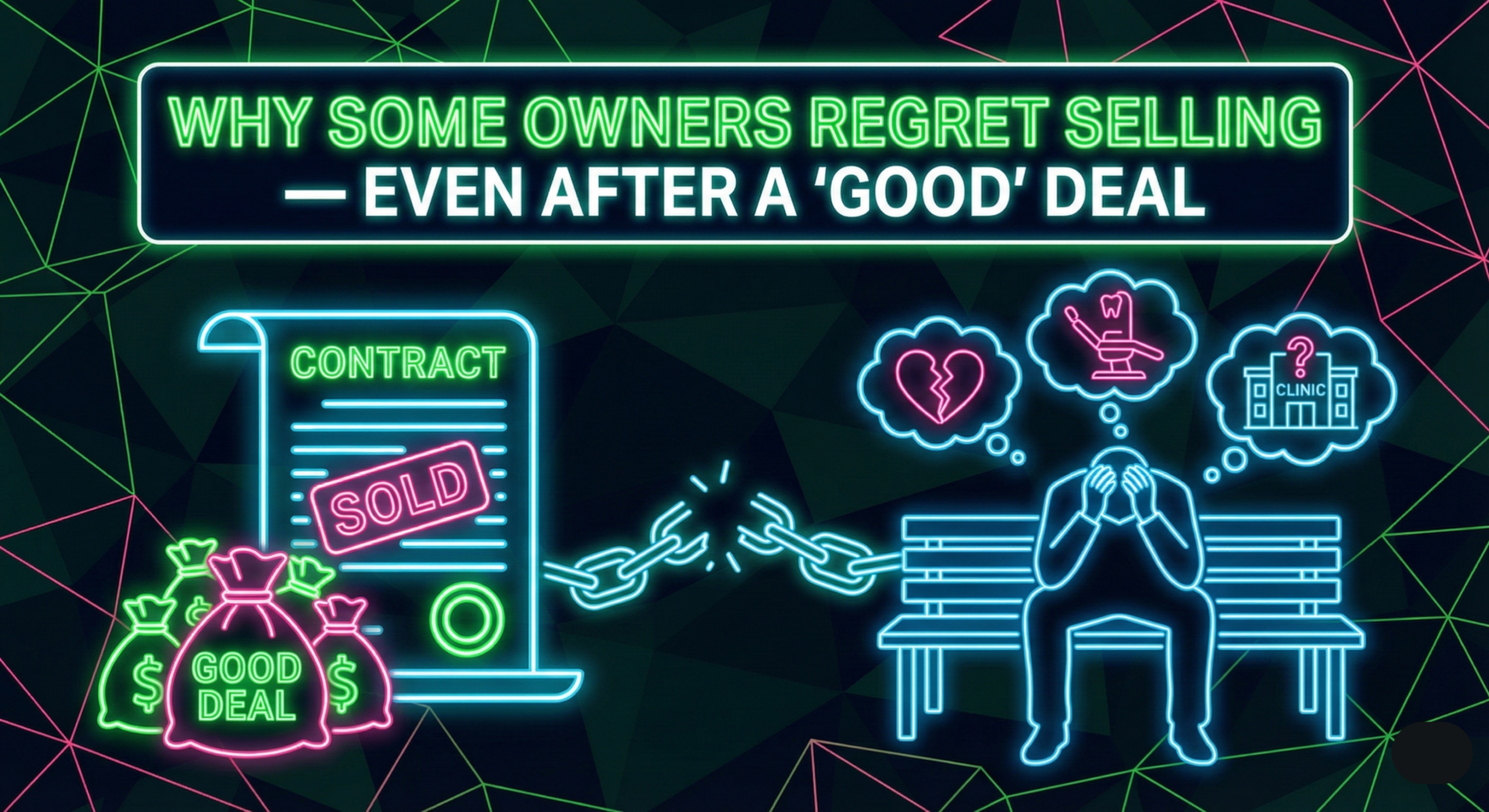
Most owners who sell their dental clinic don’t regret the decision itself.
They regret parts of the experience that no one prepared them for.
The deal made sense. The price was fair. The transition was professionally handled. On paper, everything went right.
And yet, months or years later, some owners find themselves quietly wondering why something that was supposed to feel like relief still feels unsettled.
This regret isn’t about money.
It’s about expectations.
One of the most common reasons regret surfaces is that selling is often treated as an endpoint rather than a transition.
Owners spend years building toward the sale. They imagine what life will feel like afterward. Freedom. Flexibility. Less pressure.
What’s rarely discussed is how abruptly identity can shift once ownership ends.
For decades, the clinic wasn’t just work. It was structure, relevance, and daily purpose. Decisions mattered because you made them. Problems mattered because you solved them.
When that disappears quickly, the silence can feel louder than expected.
Another source of regret comes from underestimating how different post-sale work feels.
Many sellers continue working after the sale, either by choice or agreement. What changes is not the work itself, but the context.
Authority shifts. Decision-making slows. Accountability remains, but control is shared or transferred.
For some, this feels supportive. For others, it feels constraining.
Owners who assumed the work would “feel the same, just lighter” are often surprised by how much the environment affects satisfaction.
Regret also surfaces when expectations around time and fulfillment aren’t met.
Free time sounds appealing until it arrives unstructured.
Without intentional planning, days blur together. Energy drops. Motivation fades. The sense of forward motion that work once provided disappears without replacement.
This isn’t laziness. It’s loss of rhythm.
Owners who retire away from work instead of toward something often struggle more than they expected.
Another subtle source of regret is watching the clinic change.
Even when changes are positive, they can feel personal. New systems. New priorities. New leadership styles.
The clinic evolves — as it should — but emotionally, that evolution can feel like distance.
Some owners interpret this discomfort as a mistake in selling, when in reality it’s a normal part of letting go.
There’s also regret tied to timing.
Some owners sell later than they should have, after years of exhaustion. Others sell earlier than they intended, reacting to stress or external pressure.
In both cases, regret doesn’t come from the sale itself, but from feeling rushed or depleted when the decision was made.
Selling from clarity feels different than selling from fatigue.
Perhaps the most overlooked source of regret is the absence of honest conversation before selling.
Many owners feel pressure to present confidence. They downplay doubts. They avoid exploring emotional readiness because it feels unprofessional.
As a result, they enter one of the biggest transitions of their life without fully understanding how it might affect them personally.
When feelings surface later, they feel unexpected — and therefore heavier.
It’s important to say this clearly:
Regret after selling does not mean the sale was wrong.
It means the transition was incomplete.
Owners who experience the least regret tend to share a few things in common.
They prepared their clinic to run without them long before selling.
They thought about life after the sale as deliberately as they thought about valuation.
They understood that identity would need time to recalibrate.
They expected the transition to feel human, not clean.
Those expectations softened the landing.
Selling a clinic is not a moment. It’s a process that unfolds over years — before and after closing.
Owners who understand that are less likely to romanticize the sale or resent the outcome.
They don’t measure success by whether they feel relief immediately.
They measure it by whether their life, over time, moves toward what they actually wanted.
Regret doesn’t come from selling.
It comes from selling without preparing for who you’ll be afterward.
And that preparation is possible — long before the first conversation ever happens.
Comments are closed