
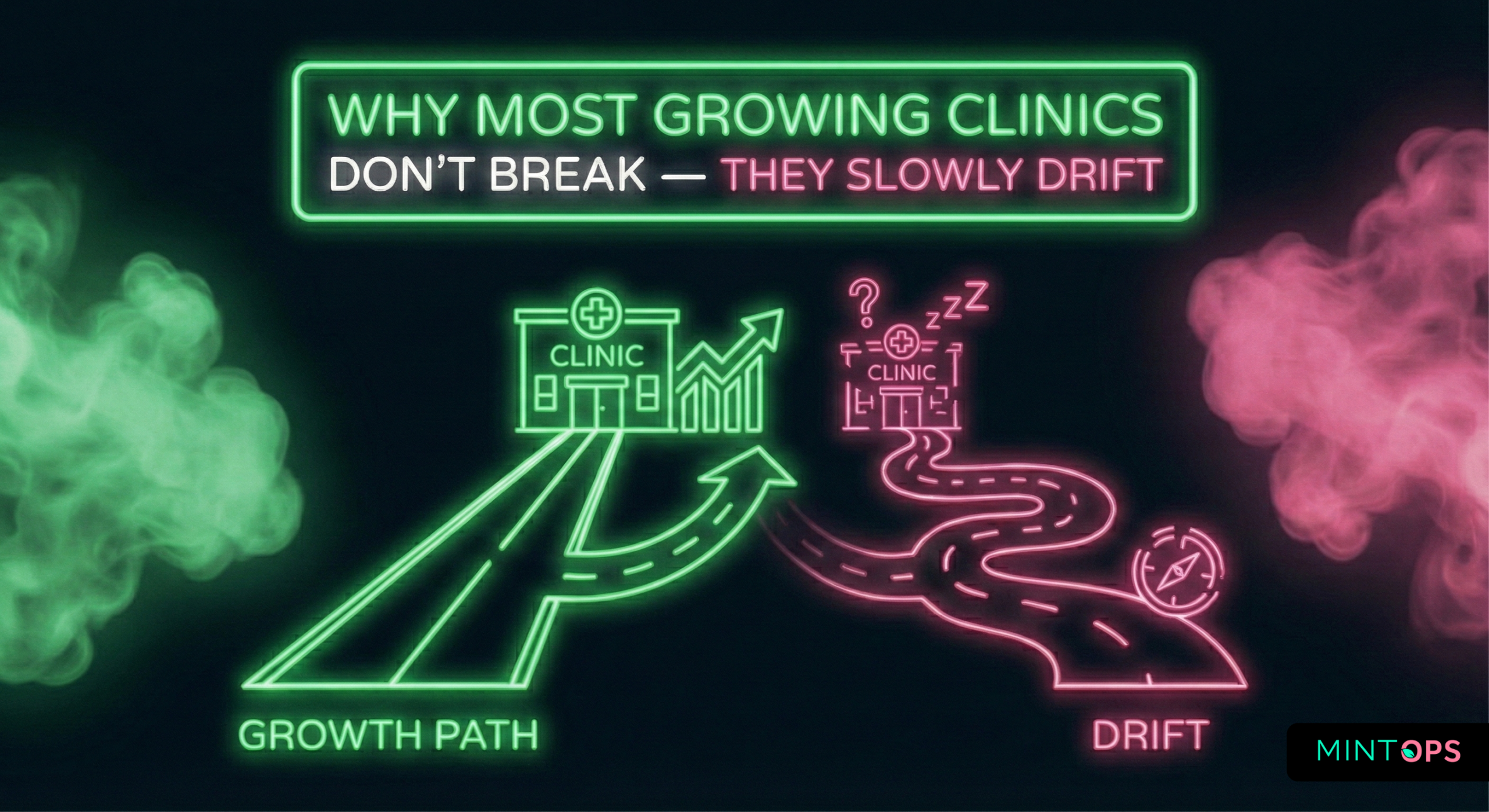
Most clinics don’t fail because something dramatic or catastrophic happens. They don’t wake up one morning to locked doors, empty schedules, or an obvious operational collapse. In fact, many of the clinics that eventually struggle still look successful on the surface right up until the moment things begin to feel unmanageable. What actually happens is quieter, slower, and much harder to notice. Clinics don’t usually break — they drift.
From the outside, a drifting clinic often looks healthy. The schedule remains full, phones are still ringing, and patients continue to come in. Revenue might even be trending upward. Yet inside the practice, the daily experience begins to feel heavier. Front desk staff are constantly switching between tasks, follow-ups are happening but not always consistently, and notes are left with the intention of being handled later. Reports no longer quite reflect what is happening chairside, and small inconsistencies begin to appear across workflows. None of these things are alarming on their own, which is exactly why drift is so easy to miss.
Operational drift does not arrive as a crisis. It rarely presents itself as a single, urgent problem that demands immediate attention. Instead, it shows up as a growing collection of small inefficiencies — recalls that quietly slip through, follow-ups that depend on memory rather than systems, data that becomes gradually less reliable, and processes that are technically defined but inconsistently executed. Teams stay busy, often extremely busy, yet still feel behind. The clinic continues to move forward, but with less clarity, less predictability, and less confidence than before.
Growth is usually what triggers this shift. As a practice becomes busier, the number of patients increases, staff numbers grow, and communication channels multiply. More systems are introduced, and the overall operational environment becomes more complex. What was once manageable through habits, memory, and informal workflows begins to exceed human bandwidth. This is not a failure of people. Teams do not suddenly become less capable. The environment simply becomes more demanding, and complexity without structure inevitably creates friction.
This friction tends to surface first in the administrative layer. Drift rarely originates in clinical care itself. It lives in the behind-the-scenes systems that support patient communication, follow-ups, scheduling, data maintenance, and daily workflow execution. These operational functions form the invisible machinery of a clinic, and they are also the first areas to feel pressure as growth accelerates. When structure and ownership are not reinforced at the same pace as demand, small cracks begin to form — and over time, those cracks widen.
The most challenging part is that drift compounds quietly. Small inconsistencies accumulate into slightly weaker recall systems, slightly messier data, slightly lower rebooking rates, and slightly more staff fatigue. No single metric collapses, but momentum slowly erodes. Owners often reach a confusing point where the clinic is busier than it has ever been, yet everything feels harder to manage. Decisions take longer. Reports inspire less confidence. Daily operations feel heavier instead of smoother.
The greatest risk in this stage is not burnout or turnover, though both can eventually follow. The real risk is the gradual loss of operational clarity. When clarity fades, performance becomes harder to measure, problems become harder to pinpoint, and growth becomes increasingly stressful instead of energizing. Clinics do not typically collapse into chaos — they quietly drift into complexity, and unmanaged complexity always wins.
Drift is not a sign of poor leadership or weak teams. It is a signal that a clinic has outgrown its original operational architecture. Signals exist for a reason. They are meant to be recognized and addressed, not ignored. The earlier drift is understood for what it truly is, the easier it becomes to restore clarity, structure, and control before complexity has the chance to take over.
Comments are closed