
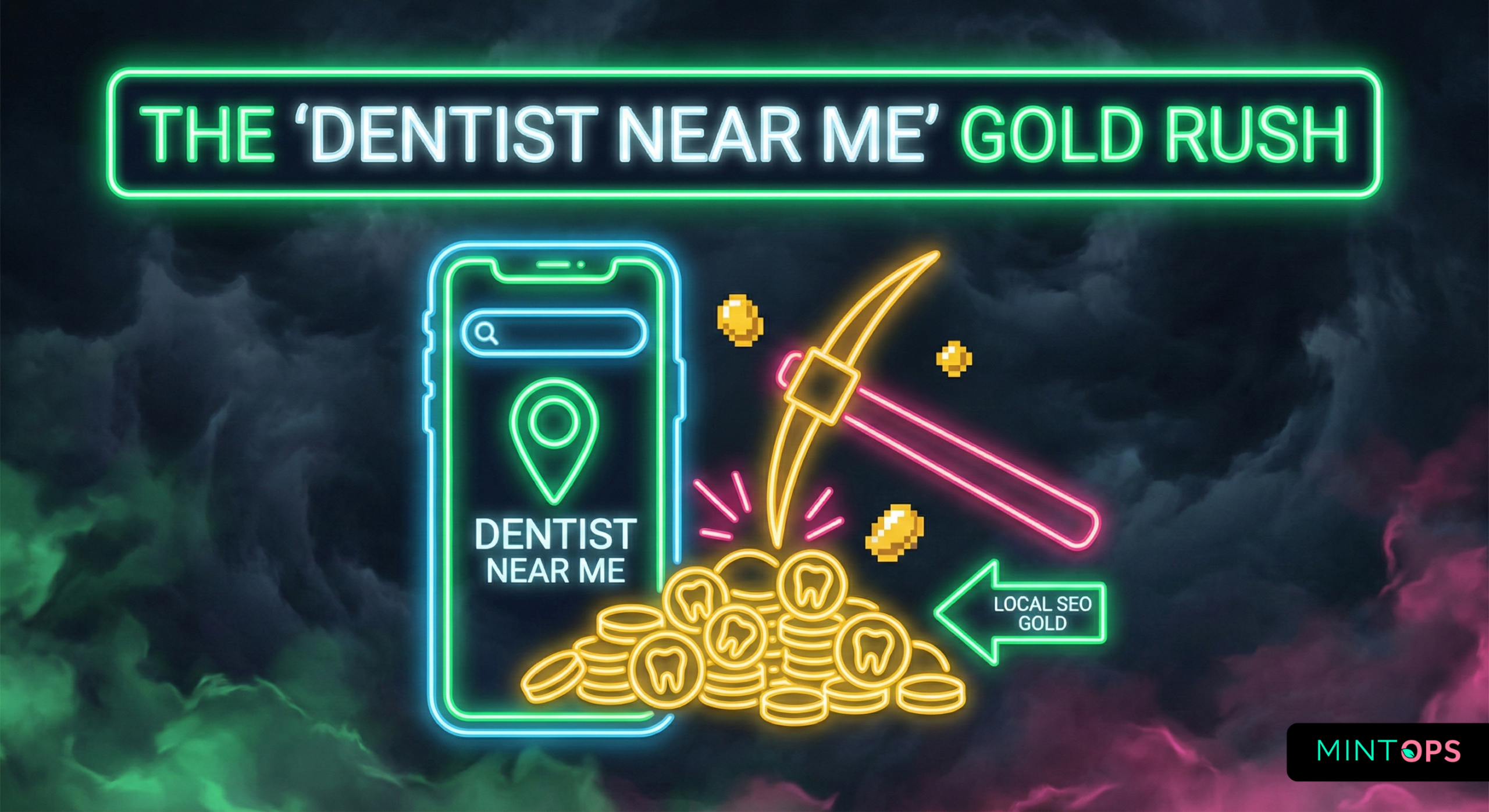
The Friday Afternoon Toothache
Picture this scenario: It is 3:45 PM on a Friday afternoon in suburban Winnipeg (or Toronto, or Vancouver). A potential patient named David bites into a hard pretzel and hears a sickening crack. Pain shoots through his jaw. He doesn’t have a regular dentist; he hasn’t been in two years.
David does what 98% of Canadians do in this situation. He pulls out his iPhone. He doesn’t type in “www.dentistjohn.com.” He doesn’t look at a flyer he received in the mail three weeks ago. He types three words into Google: “Dentist near me.”
Google’s algorithm instantly calculates David’s GPS location. Within 0.5 seconds, it presents him with the “Local Pack”—a map view showing three clinics.
- Clinic A: 4.9 Stars (128 Reviews). Open until 5:00 PM.
- Clinic B: 4.2 Stars (14 Reviews). Hours not listed.
- Clinic C: No reviews.
David calls Clinic A. They don’t answer, but their voicemail gives an emergency number. He books. Clinic A just won a patient worth potentially $50,000 over a lifetime (exams, hygiene, eventual crowns, maybe implants). Clinic B and C didn’t just lose a patient; they didn’t even know a patient was looking. They were invisible.
The Battle for Digital Real Estate
In 2026, the battleground for dental patient acquisition is no longer the billboard on the highway; it is the Google Map Pack. “Local SEO” (Search Engine Optimization) is the specific science of ranking in that 3-pack. It is distinct from general SEO. General SEO helps you rank for “What is a root canal?” globally. Local SEO helps you rank for “Root canal in [My Neighbourhood]” specifically.
For a dental practice, Local SEO is the highest-ROI marketing activity you can perform. Why? Because the “intent” is incredibly high. Someone searching for “dentist near me” is not browsing for fun. They have a problem, and they want a solution now.
The Three Pillars of Google’s Algorithm
To win, you must understand the rules of the game. Google judges your clinic based on three primary factors:
- Relevance: Does your business profile match what the user is typing? If they type “Invisalign,” does your profile explicitly mention clear aligners, or just “general dentistry”?
- Distance: How far is the user from your front door? You cannot control this factor (you can’t move your building), but you can control how well you dominate your immediate 5km radius.
- Prominence: This is the popularity contest. How many reviews do you have? Are other local websites linking to you? Do you have a strong social media presence?
Step 1: The “Review Velocity” Strategy
Most dentists misunderstand reviews. They think, “I have 50 five-star reviews from 2023, so I am good.” Google disagrees. The algorithm prioritizes Review Velocity—which means the frequency and recency of new reviews. A clinic with 300 reviews that hasn’t received a new one in six months looks “dead” to Google. A clinic with 80 reviews that gets two new ones every single week looks alive, active, and relevant.
You cannot rely on passive hope. You need an active system. The best practices we implement involve automated text messaging (SMS).
- The Wrong Way: Putting a sign at the front desk saying “Review Us!” (Nobody does this).
- The Right Way: A text message sent 45 minutes after the appointment: “Hi Sarah, thanks for visiting! It helps our small team huge amount if you could click this link and tap 5 stars.” This friction-less approach is the only way to build the Prominence score required to rank #1.
Step 2: NAP Consistency (The Silent Killer)
NAP stands for Name, Address, Phone Number. It sounds trivial, but inconsistent data is a silent killer of rankings.
- Is your clinic listed as “Main Street Dental” on Google?
- But listed as “Main St. Dental Clinic” on YellowPages?
- And “Dr. Dentistry” on Facebook?
If Google sees these discrepancies, it gets confused. It wonders, “Are these the same business? Is this data reliable?” When Google is confused, it drops your ranking to be safe. You must ensure your digital footprint is identical across every platform on the internet.
Step 3: Local Content Signals
Stop writing generic blogs. A blog post titled “Why Flossing is Important” puts you in competition with Colgate, Mayo Clinic, and Wikipedia. You will never beat them. Instead, write content that only you can write.
- “The Cost of Dental Implants in [Your City].”
- “Emergency Dental Options in [Your Neighbourhood].”
- “School Sports Mouthguards for [Local High School] Athletes.”
This strategy sends “Local Signals” to Google. It tells the search engine, “We are not just a dentist; we are the dentist for this specific community.”
The Metric That Matters: Calls, Not Just Clicks
Finally, you must measure the right things. Many agencies will send you reports showing “Impressions” or “Clicks.” These are vanity metrics. You can’t pay your staff with impressions. You need to track Calls and Booked Appointments. Integrating call-tracking software allows you to see exactly which keywords drove the phone to ring. Did the patient find you via “Teeth Whitening” or “Emergency Exam”? If you are seeing traffic but the phone isn’t ringing, you likely have a conversion problem on your website. Running a comprehensive SEO audit is the first step to diagnosing why your digital traffic isn’t converting into physical patients.
Comments are closed