
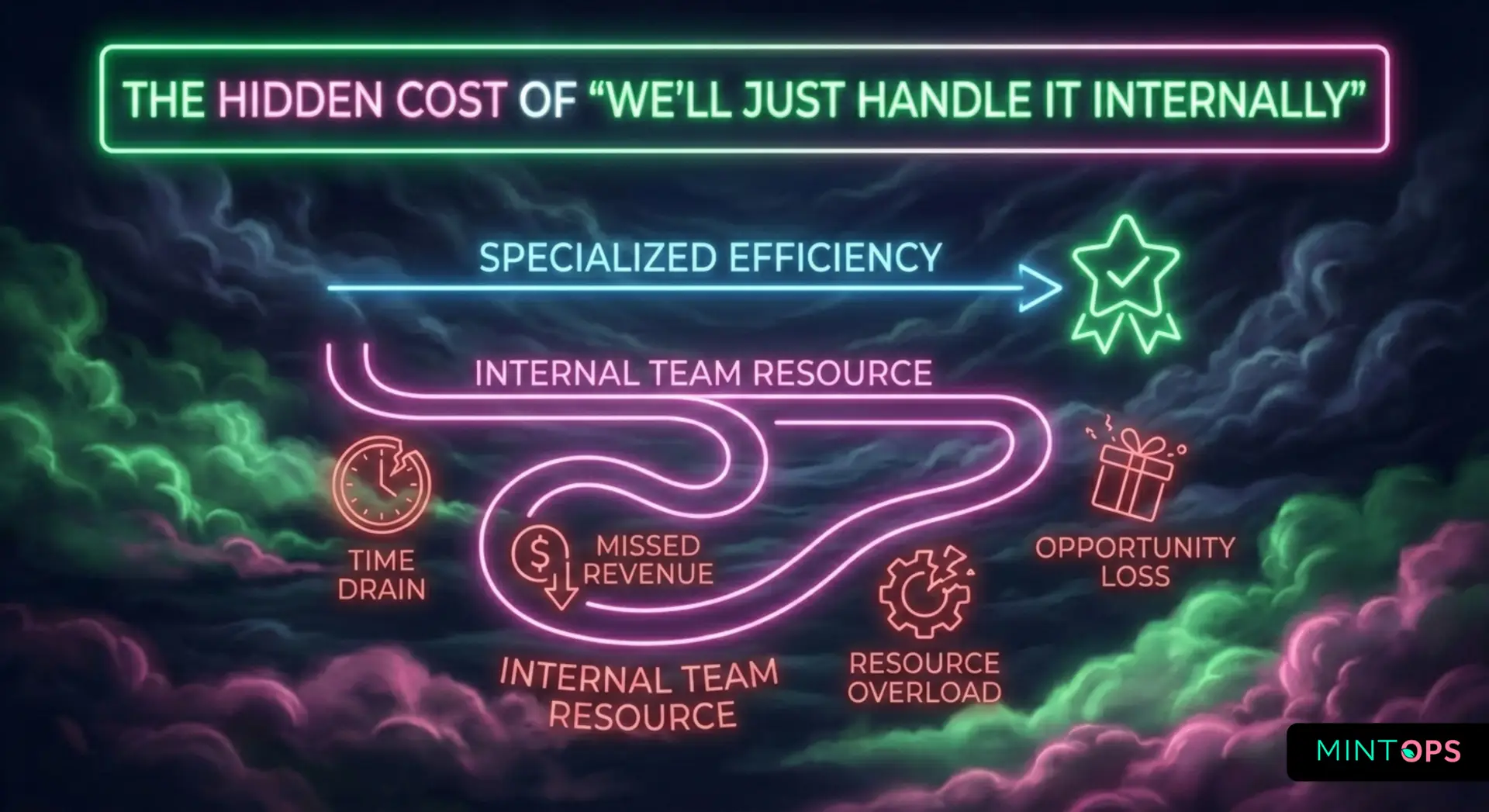
Almost every clinic reaches a moment where the workload begins to feel heavier than it used to. It doesn’t happen overnight. It shows up in longer days, fuller schedules, and the growing sense that there is always something waiting to be done. When that moment arrives, the most natural response is also the most dangerous one: we’ll just handle it internally.
On the surface, this sounds responsible. It feels loyal to the team. It feels efficient. Why outsource something when you already have capable people in the building? Yet over time, this decision quietly reshapes the clinic in ways that are rarely intended and even more rarely noticed.
At first, the solution seems to work. Someone picks up recall follow-ups between patients. Another team member starts helping with insurance calls during slower moments. Data cleanup gets added to the end of someone’s day. Nothing dramatic changes — which reinforces the idea that the clinic has made the right call. But what is actually happening is not efficiency. It is compression. More work is being forced into the same staff members.
People do not experience this compression as a system problem. They experience it as personal pressure. They move faster, multitask more, and begin carrying mental lists that never fully empty. Tasks that require consistency slowly become dependent on memory. Follow-ups that should be executed through structure begin to rely on “when there’s time.” Over time, the work still gets done — just not in a predictable or repeatable way.
This is where hidden cost begins to form.
It shows up in subtle ways. Recall systems quietly lose their edge. Booking accuracy becomes less consistent. Patient communication varies depending on who happens to be on shift. Data becomes harder to trust, not because anyone is careless, but because no one has protected time to maintain it properly. Staff begin to feel busy all day while still feeling behind. The clinic becomes more reactive, less measured, and less calm — even as revenue grows.
Leadership often feels this before it can clearly see it. Decisions become harder to make because the information behind them feels less solid. Problems take longer to surface because no one owns the full picture. Small issues linger longer than they should. The clinic is not failing — but it is losing its sense of operational certainty.
What makes this pattern so persistent is that nothing looks broken. The clinic is still open. Patients are still coming. The team is still showing up and doing their best. There is no obvious crisis to trigger change. The cost remains hidden inside slower processes, heavier days, and the quiet erosion of clarity.
Over time, the phrase “we’ll just handle it internally” stops being a temporary solution and becomes a permanent operating model. And permanent compression always extracts a price — not in a single dramatic moment, but through gradual fatigue, reduced consistency, and increasing complexity.
The hardest part is that the instinct itself is good. Clinics choose this path because they care about their people, want to be responsible, and believe in solving problems in-house. But growth changes the rules. What once worked through goodwill and effort eventually requires structure, defined ownership, and protected execution layers.
The cost of handling everything internally is not that people can’t do it.
It’s that eventually, everything becomes harder than it needs to be.
And that is how good clinics slowly trade clarity for complexity — without ever meaning to.
Comments are closed