
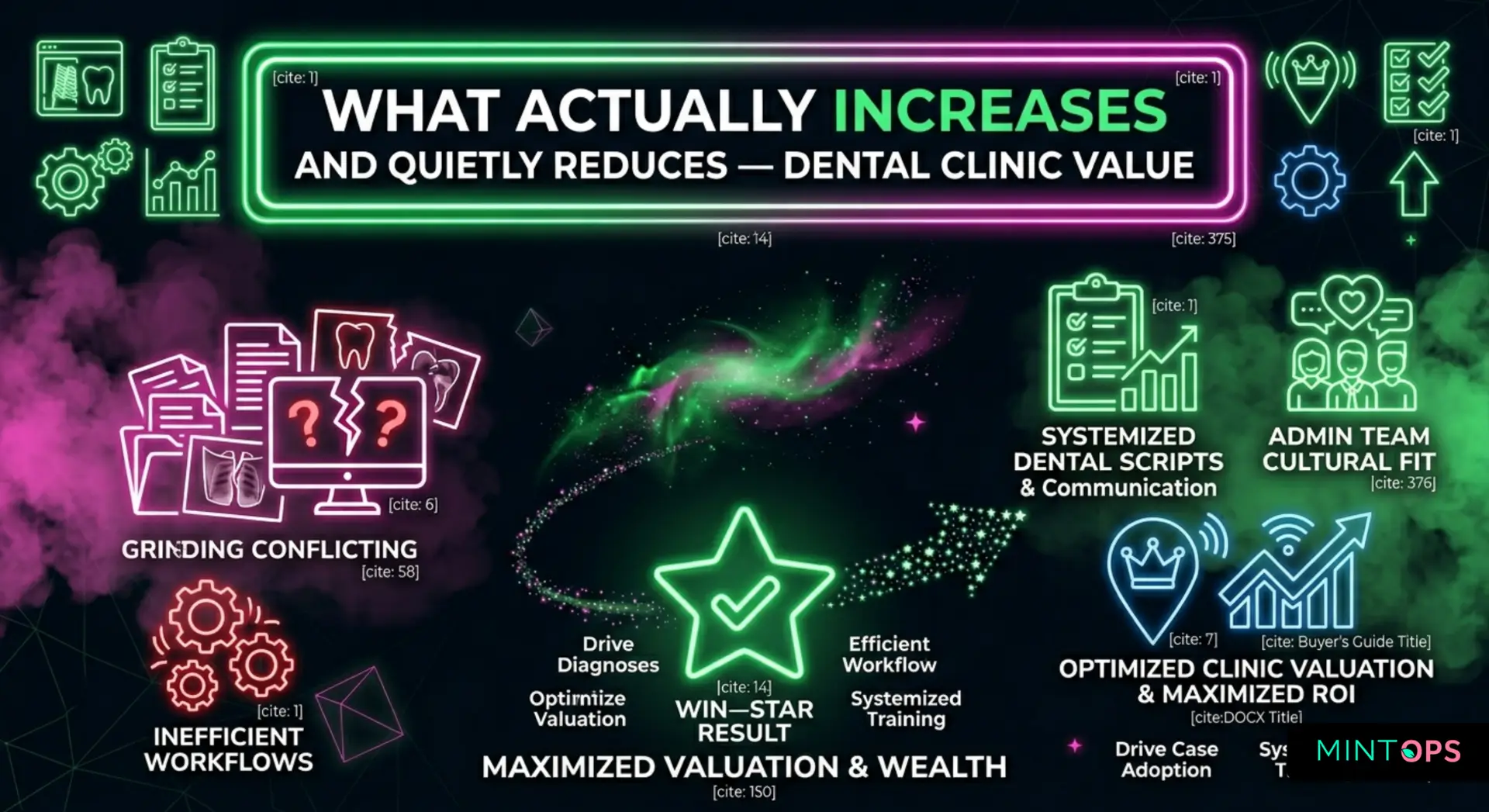
When owners talk about increasing the value of their clinic, the conversation almost always turns into growth.
More production.
More patients.
More chairs.
More days.
Growth matters, but it’s rarely the primary driver of valuation outcomes. In many cases, it’s not even the most effective lever.
What truly increases clinic value is not how big the business is, but how understandable and predictable it appears to someone who didn’t build it.
That distinction explains why some clinics outperform expectations in a sale, while others struggle despite strong numbers.
Value grows when risk shrinks.
That’s the simplest way to think about it.
Buyers don’t pay premiums for effort or sacrifice. They pay premiums for confidence — confidence that the business will continue performing without disruption once ownership changes.
Everything that increases confidence supports value. Everything that introduces uncertainty quietly reduces it.
One of the most consistent value builders is operational predictability.
Clinics that run the same way week after week, regardless of who is working, feel safer to step into. Schedules make sense. Recall behaves as expected. Hygiene capacity is stable. Problems still occur, but they are resolved through processes rather than improvisation.
From the outside, that predictability signals maturity.
From the inside, it usually feels calmer.
Another major driver of value is clarity around financial performance.
Buyers don’t need perfect numbers. They need understandable ones.
When earnings can be explained without caveats, when fluctuations make sense, and when owner compensation is clearly separated from business performance, confidence rises. The story becomes easier to tell. Financing becomes easier to secure. Negotiations become more straightforward.
Messy financials don’t necessarily reduce value directly — but they increase perceived risk, and risk changes how buyers behave.
Clean, reliable data is often underestimated as a value driver.
Reports that reflect reality reduce friction in diligence. Systems that align reduce questions. Definitions that are consistent reduce debate.
When data feels trustworthy, discussions move faster. When it doesn’t, buyers slow down, probe deeper, and become more conservative.
Value isn’t just about what the data says. It’s about how much effort it takes to believe it.
Low dependency risk is another quiet but powerful contributor to valuation.
Clinics that depend heavily on one person — often the owner — feel fragile to outsiders, even if performance is strong. Buyers ask themselves what happens if that person steps away, reduces hours, or leaves entirely.
When leadership, decision-making, and knowledge are distributed rather than concentrated, the business feels more durable. That durability supports stronger outcomes.
On the other side of the equation, some of the biggest value reducers are subtle.
Owner dependency is one.
Undocumented processes are another.
Inconsistent recall logic.
Unstable hygiene.
Numbers that require explanation.
Systems that don’t align.
Individually, these issues may seem manageable. Collectively, they introduce friction and uncertainty.
None of them mean a clinic is failing. They mean the business is harder to transfer.
One of the most common mistakes owners make is assuming buyers will “fix things later.”
They might — but fixing things later increases risk. And increased risk is priced in.
Clinics that address issues proactively tend to maintain leverage. Clinics that defer clarity often lose it.
It’s also worth noting that aggressive growth can sometimes reduce value if it introduces instability.
Rapid expansion without systems, staffing growth without structure, or increased volume without predictability can make a business feel fragile rather than impressive.
Buyers are cautious about growth that hasn’t settled.
Stability often matters more than speed.
Ultimately, valuation rewards businesses that are calm.
Calm in their operations.
Calm in their numbers.
Calm in their structure.
That calm signals that the business doesn’t require constant intervention to survive.
The clinics that achieve the strongest valuation outcomes are rarely the ones chasing a specific price.
They’re the ones that focused on building businesses that made sense to someone seeing them for the first time — without explanation, without heroics, and without constant oversight.
Value grows quietly when uncertainty is removed.
Comments are closed